
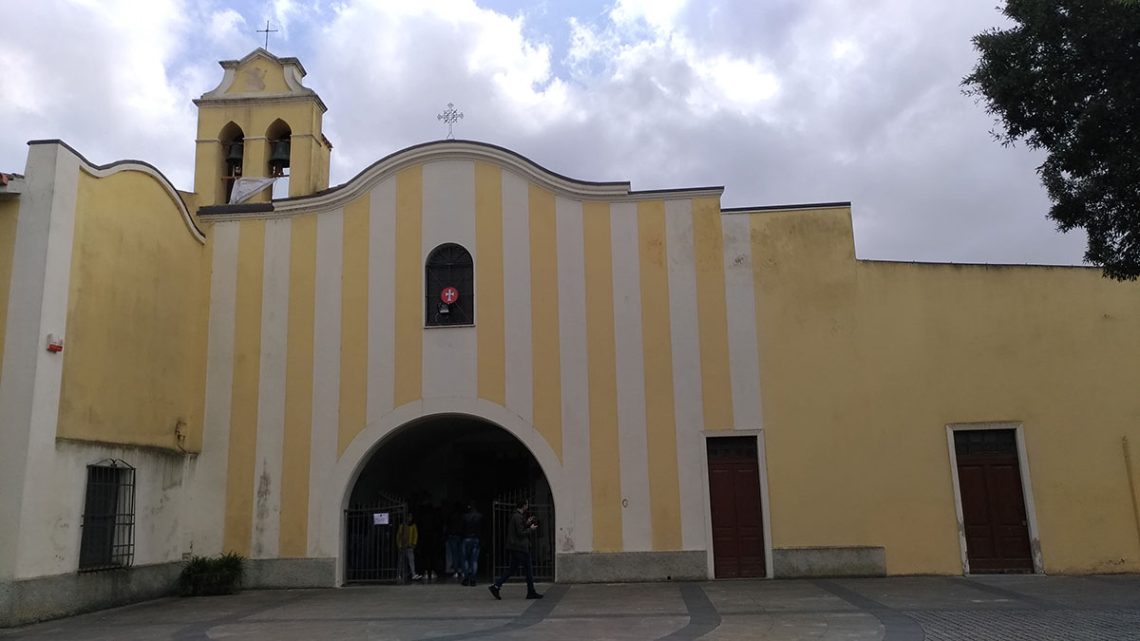
>>> 🐧NEW ONE SIBA 2025 🐧<<< 165DA/CH068 (Chiesa e Convento di Santa Lucia) (by 165DA101 Alex) / 1 POINTS./ DATE: 18 april 2025 start @ 13.30 UTC / Freq. 7️⃣0️⃣5️⃣ SPLIT +10 Khz UP / PROVINCE 117 (Medio Campidano)/ Historical Region HR02 (Monreale) / Municipality H856 (San Gavino Monreale)
ANT: 3 EL. BIRD YAGI / PW from 200 to 400W
The church and convent of Santa Lucia (su guventu) is the oldest monument, of Early Medieval origin, found in the territory of San Gavino Monreale, dating back to the 9th-10th century. Built on previous Nuragic settlements, it was later renovated by the first monks of the Greek-Byzantine rite who arrived in Sardinia in those centuries. It is assumed that it was – initially – a chapel/aedicule of Basilian monks; there are many elements supporting this hypothesis: first of all the fact that these monks were cenobitic (they met in community places), and often consecrated pagan places into Christian ones.
The first hypothesis is confirmed by the discovery, in the anterefectory, of traces of an ancient dome with almost intact corbels, with vine leaves in relief and which, according to Father Iliario Orrù, are to be attributed to Greek matrices; the second hypothesis, also reported by Father Orrù, is that in the center of the cloister a spring was discovered covered and closed by walls, which was accessed via stairs, and which was probably traced back to the cult of the waters of the Nuragic people; as happened in other places, Christians reconverted places like these to the Saints, in this case Saint Lucia, a martyr from Syracuse and blessed for the cure of blindness, which often occurred through water.
The cloister is a very beautiful and fragile work, with the oldest roof built in juniper wood, which however becomes stronger as it becomes older. Furthermore, there are two tombstones with medieval inscriptions in Gothic and dating back to the 12th and 13th centuries, a sign of the burial of Pisan-Tuscan people (and perhaps the place continued to maintain its cemetery function for centuries). Of the original structure it is therefore possible to see the ancient barrel vault, the heavy arches, as well as the two engravings in Greek with the words “men of Basil” and “Aetione”, although written with abbreviations of the Benedictine school.
After the 11th century – with the great schism between the Western and Eastern Churches – the Basilian monks were forced to leave and the convent was taken first by the Benedictines, then from the 16th century by the Franciscans, brought by the Spanish power, who continued to expand the building and carry on its activity; in fact, the writing “1541” dates back to those years, found engraved on a block that joined the sacristy with the small church, a date that however is a few years before the arrival of the Franciscan monks.
In some chapels inside the church there are marble altars – from the 16th century and later – with a particular cross, which is very reminiscent of the symbol of the Knights Templar, who however had already been abolished and outlawed by the established authorities of the time.
The monks of the Convent also ran a school, the University of Theology and Letters, with an important library starting from around the 17th century. As evidence of the social role of this place for the community of San Gavino, there are numerous attestations of bequests, wills and economic transactions that private citizens or authorities paid to the monks of the church; in addition to this, there were buildings in front of the church itself, called buttegheddas de guventu, or a long row of rooms that the religious gave to the pilgrims who came for the feast in honor of the saint.
https://www.sangavinomonreale.net/2014/06/04/la-chiesa-di-santa-lucia/.

Are you in the Log? Click below.
| LOG |
| 1AT562 Antonio 14DA020 Pascal 1AT771 Marco 165AT448 Franco 1LR119 Vittorio 1DA006 Sergio 3AT140 Marcos 1LR011 Gabry 30DA010 Sergio 34AT116 Belen 34AT192 Nando 14AT824 Philippe 1AT535 Alessandro 14DA496 Marino 29AT038 Tim 1PAT198 Maurizio 14AT047 Yohann 34DA010 Saul 3AT303 Renato 11AT121 Carlos 91AT777 Hakiem 1TW025 Claudio 1AT120 Pierre 3DA001 Tullio 47DX054 Leif 1AT014 Vincenzo 13AT285 Tommy 3AT135 Paulo 1SD016 Alex 3DA010 Marcio 14GT044 Pierrot 26AT016 Paul 1AT682 Giuliano 14RA041 Chris 14AT145 Philippe 1AT586 Franco 161DA135 Sylvester 1SA010 Stefano 91AT109 Agus 14DA021 Phil 1AT127 Luciano 108AT046 Jim 34DA183 Juan Carlos 24EK011 Gregorio 1EK156 Mauro 97LC005 Juda 1AT227 Livio 56SD106 Ville 1DA005 Gaetano 14CI177 Olivier 14AT016 Bruno 13AT715 Pete 14AT222 Willy 14SD501 Hervé 1DA007 Darek 14AT832 Christian 19AT515 Ron 14AT075 Georgette 14DA062 Gerard 16AT128 Stephane 30DA021 Andoni 136WI005 Steph 19LR001 Ger 1AT730 Claudio 1PC074 Mattia 14SD213 Mario 23SD101 Glen 5KPI052 Pinto 29LR049 Michael 14AT371 Michel 31LR001 Rui Sousa 26NB352 Paul 13WM019 Wim 1AT485 Riccardo 14AT201 Farid 14CF009 Philippe 14SR117 Daniel 14EM011 Titi 1SD014 Fabio 3AT101 Fernando 5SD015 Pedro 5SD011 Alejandro 10W001 Alejo 14DA069 Thierry 1AT040 Franco 14WM057 Yann 29AT101 Mike 14AT114 Allan 5SD017 Juan Carlos 14AT210 Gerard 14AT148 Philippe 29AT057 Noel 19AT103 René 73AT101 Andris 108AT041 Grant 31LR198 Luis 35SSB079 Bjorn 165PAT104 Pierpaolo 34VAG379 Victor 3PAT704 Josemar 119AT116 Humberto 34ASM078 Ayoze 44EK150 Zain 153DA181 Fred 1ALE013 Alessandro 34RC404 Yeray 29AT104 Joe 3VS009 Marcos 1AT1602 Franco 3SKD008 José Mauricio 14GT054 Gerald 14AT224 David 14AT177 Manu 14AT661 Gerard 3B003 Bila 75EK105 Andrade 1AT194 Marco 1WM344 31AT347 Nuno 3AT515 Marc |

 WBA - HOME PAGE