
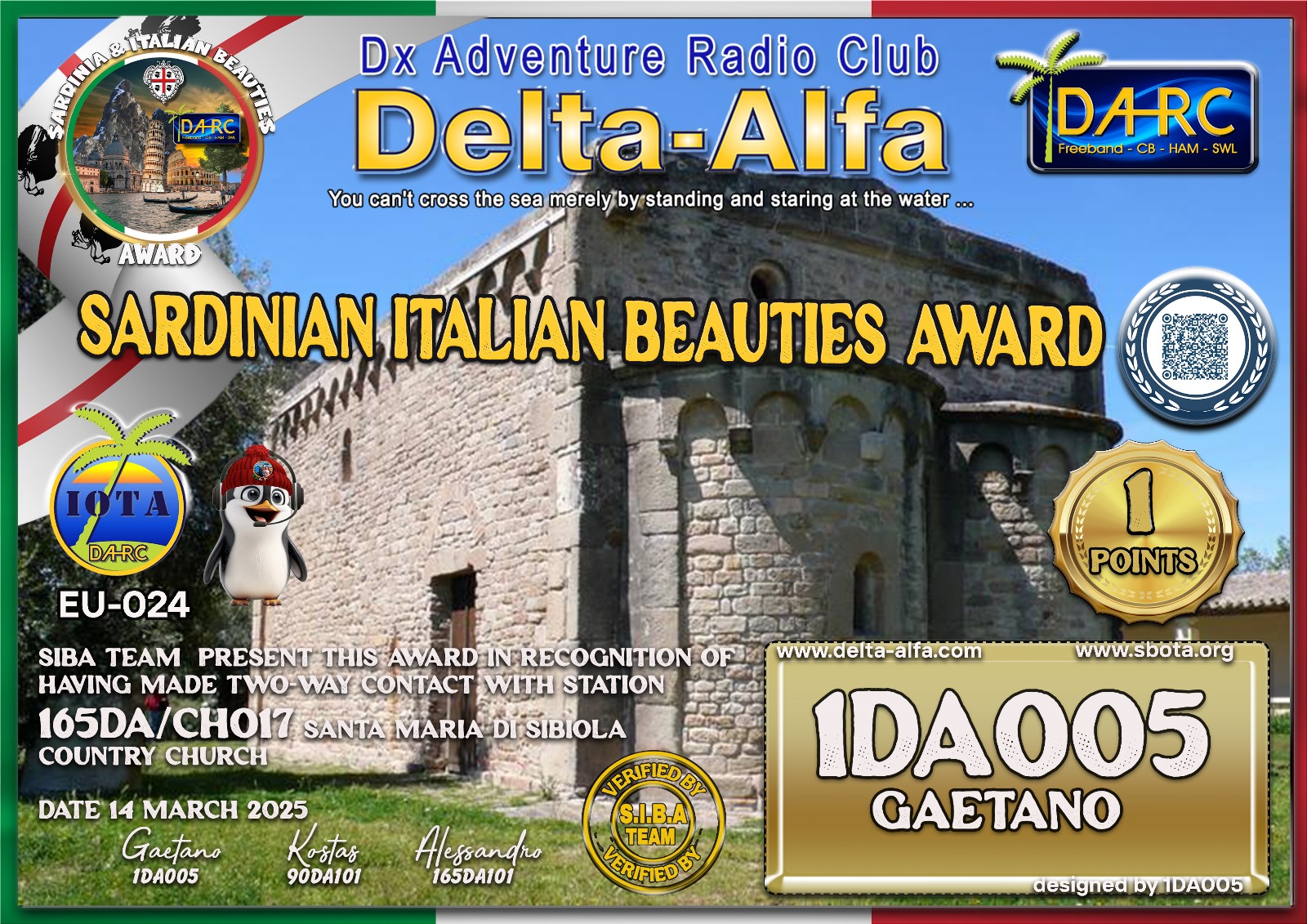
>>> 🐧NEW ONE SIBA 2025 🐧<<< 165DA/CH017 Santa Maria di Sibiola Country Church (by 165DA101 Alex) / 1 POINTS./ DATE: 14 march 2025 start @ 14.30 UTC / Freq. 7️⃣0️⃣5️⃣ SPLIT +10 Khz UP / PROVINCE 318 (Città Metropolitana di Cagliari) / Historical Region HR07 Parteolla / Municipality I624 (Serdiana)
ANT: SKYPPER / PW from 200 to 400W
A masterpiece of Romanesque art in the fertile Serdiana countryside, twenty kilometres from Cagliari, in southern Sardinia, as well as being part of the island’s medieval heritage. It is one of the best preserved medieval Romanesque-Pisan buildings on the island. The church of Santa Maria stands on a slight plateau, surrounded by hills planted with vines and olive groves, three kilometres from the town of Serdiana, in the historic territory of Parteolla, where between the villa of Sibiola prospered from the 12th to 16th century. The rural ‘tempietto’ was probably built around 1125, made in sandstone by workers called by the Benedictines of the Abbey of San Vittore di Marsiglia, who settled in the southern Campidano area between the late 11th and early 12th centuries and contributed greatly to the development of the rural village. The first written record of Santa Maria di Sibiola is later (1215), and was still the property of the Benedictines of San Vittore in 1338. The church was named a few years later.Its simple Romanesque façade, restored in 1960-62, is made up of squares of trachyte that create vivid colours. It has two arched portals surmounted by a single lancet window and a mullioned window respectively. The façade is framed by two pilasters that intersect horizontally with a series of nine hanging arches on decorated pediments, which run along the terminal. The pilasters and arches also continue along the sides and the external part of the apses, sculpted with zoomorphic, phytomorphic and geometric motifs. At the centre of the façade you will notice a squared slab with inlays and another with an engraving that recites Domini et Mariae. On the left side there is the access staircase to the roof and the bell tower, of which only the basic segments remain. The stone corbels fixed in the wall recall the steps of the nuraghes. The interior has a rectangular outline divided into two naves of different sizes, both barrel-vaulted, closed with semi-circular apses and divided by four round arches, similar to those of the Basilica of San Saturnino in Cagliari. The lesenes are variously decorated with classicist and Byzantine motifs. The decor is in typical 12th century Romanesque style: a single altar in the main nave surmounted by a wooden crucifix, and a niche with a statue of Saint Anne with an infant Mary in the smaller apse. The original Romanesque holy water stoup is now held in the parish church of Santissimo Salvatore, built between the 15th and 16th centuries in neoclassical and Late Baroque style. Also in the past, the tableau of the Universal judgment was located behind the altar, a 15th century work attributed to the master of Olzai (probably Antonio or Lorenzo Cavaro). The two surviving parts of the painting are kept in the National Art Gallery of Cagliari. One shows the Inferno below with an illustration of the sufferings of the damned, Purgatory with St. Michael the Archangel and the Madonna as a mediator between sinners and Christ, and Paradise with a group of souls and two angels praying at the Saviour’s feet surrounded by saints. The upper part shows the ‘Annunciation’ and sending of the Holy Spirit. The other section depicts saints Matthew and Anthony Abbot and the Adoration of the Magi. A copy of the altarpiece is on display in the council chamber of the Municipality of Serdiana, an area famous for olive growing and, above all, the production of fine wines. The historic center has several well-preserved “courtyard” homes, including the Mura house dating from 1855, the Roberti castle (18th century) with two crenelated towers enclosing the noble residence, and the suggestive church of Sant’Antonio da Padova.
https://www.sardegnaturismo.it/en/explore/santa-maria-di-sibiola.
Are you in the Log? Click below.
| LOG |
| 1AT562 56TR277 29AT038 56SD106 108CT338 68AT121 34AT192 20EK020 108AT046 1AT127 1AT682 29AT101 29LR049 29AT057 34VAG379 47AT124 1LR119 14DA021 1AT311 34DA101 29AT104 1AT227 24EK011 14DA496 14AT145 14AT047 14DA062 1AT586 19AT515 20LR117 23SD101 34ASM078 14AT292 14AT016 14AT824 13AT715 3AT135 31AT183 3SD025 26AT016 13AT285 56AT108 14GT044 1SA010 165PAT104 1AT1911 30DA010 5RC024 1LR011 47PL122 3AT086 14AT023 14SD501 14DA020 1AT771 1EK156 14AT371 9AT124 1AT289 1AT1875 1TW025 165AT448 1AT1012 1AT1171 1AT014 161DA015 56LR555 68OP115 3AT140 14AT148 35SSB079 13AT013 3AT059 14CI177 34AT116 14PAT928 19LR001 26NB352 14AT661 56SD173 14DA070 14RC066 56DR027 1VL063 68SD021 9BC235 13IR121 68AT104 14AT350 14AT224 14CI312 68AT143 1AT158 153DA181 9EK945 14AT029 1SD014 13WM019 91AT149 1SD183 327PX011 26AT022 14SR117 9AT193 108SP001 1DA006 29WM062 47DX054 26AT378 34DA010 165AT108 26AT023 108AT122 1AT057 161DA135 3B003 14AT832 108DD089 56LW066 30AT198 26AT169 1AT040 14DA001 14VL049 10MEX001 14DA017 1AT535 14VL245 1RIR214 327AT011 10RC156 1RIR005 15KW001 19RC001 21CT034 158EK115 16AT128 329AT101 1PAT198 14SD213 165AT103 165AT134 |

 WBA - HOME PAGE