
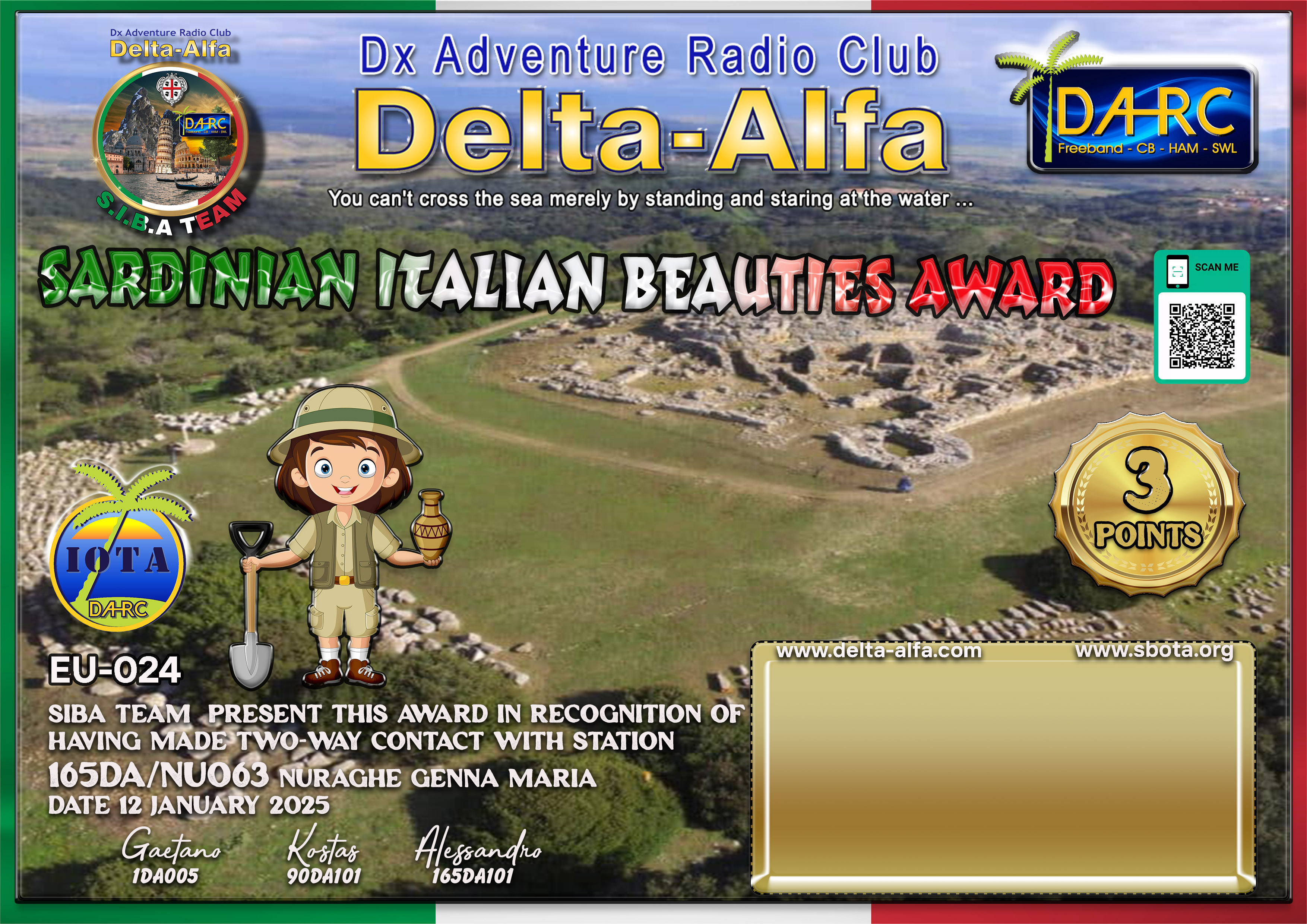
>>> 🐧NEW ONE SIBA 2025 🐧<<< 165DA/NU063 Nuraghe Genna Maria / 3 POINTS./ DATE: 12 january 2025 start @ 08.00 UTC/ Freq. 7️⃣0️⃣5️⃣ SPLIT +10 Khz UP / PROVINCE 117 (Medio Campidano)/ Historical Region HR04 Marmilla/ Municipality (Villanovaforru L986)
ANT: SKYPPER / PW 400W
NURAGHE AND GENNA MARIA MUSEUM or Genna e Mari (gateway to the sea)An imposing monument from 3,500 years ago has brought prestige to Villanovaforru: it stands in Marmilla, an area full of Nuragic remains, (as well as the recent discovery in the very interesting and worth visiting site of Pinna e Maiolu) in the center-south of SardiniaAt over 400 meters above sea level, immersed in a tree-lined park scented by Mediterranean essences, it dominates the entire Marmilla: the view reaches as far as the Gulf of Oristano (presumably in this regard its name “gateway to the sea”, given that the sea, 3,500 years ago pushed further inland, it could have been one of the first settlements after the arrival from the navigation journey) to the west and up to Cagliari, 50 kilometers away, to the south. The Nuragic complex of Genna Maria stands to welcome the territory on a hill one kilometer from Villanovaforru, village, founded under Spanish rule, which became famous after its discovery in the mid-twentieth century. It is a nuraghe with a complex structure: originally, in the 15th century BC, a central tower (ten meters high) with an internal chamber was surrounded #museoarcheologicogennamaria by a bastion with three large towers joined by thick walls, which still enclose a courtyard with a well partly dug into the rock. In a second phase, at the beginning of the Late Bronze Age (13th century BC), the tower was enclosed and partially re-lined by a bastion with four towers with skylights. In turn, the quadrilobate outer wall, which presumably had a defensive function, was enclosed (11th BC) by a mighty wall with six corner towers. Inside and outside of it there is the village, born around the 10th BC and built in several phases, as evidenced by the evolution of the houses. The most recent huts have complex structures with a central plan, with elliptical, quadrangular and rectangular rooms, functional and decorated with various shapes. The ‘central courtyard house’ is exceptional, 150 square meters wide and divided into rooms that converge in a single courtyard.The complex remained unpopulated for a long time in the Iron Age, then, in the Punic-Roman era (from the 4th century BC), it was used for votive purposes in honor of Demeter and Kore: in the open-air courtyard, bloody animal sacrifices were carried out, while in the center of the room there was the shrine intended for a simulacrum and votive offerings of the faithful. The intense life phase of this Nuragic community is followed by a violent episode, as shown by the traces of fire on the wooden roofs and the red walls of the houses “…” This episode is to be placed chronologically around the end of the 9th century BC, and perhaps because of it everything was left as it was at the same time and everything was preserved so that it reached us.For a long period, at least until the 4th century BC, excavations have documented the abandonment of the Genna Maria hill and sporadic traces of human presence.The precious finds, 600 lamps, coins, glass and clay vases, flasks, jugs, ember holders, the beautiful pintadere, 8 found on this site, cooking cups, millstones, animal bones, can be referred to seven centuries of frequentation and testify to the industriousness of the Nuragic and post-Nuragic community. Today they are kept in an elegant nineteenth-century building in the center of the town, once a ‘granatic mountain’, which has become the Genna Maria archaeological museum. It also displays pre-Nuragic, Nuragic, Punic, Roman and late-ancient finds from settlements, necropolises, monumental tombs of the Marmilla towns that form the sa Corona Arrubia consortium. Inside we were able to relive the phases of daily life of the Nuragic peoples and the evolution of sacred rites, up to the Roman and Byzantine ones. We breathed the air of a center populated and frequented by different cultures, an immortal witness of a past that we are retracing with great emotion.
https://www.neroargento.com/page_galle/gennamaria_nur_gallery.htm.
https://www.facebook.com/share/iBNCUr1R6PYFSPf6/
Are you in the Log? Click below.
| LOG |
| 108CT338 29LR049 14DA021 14DA496 1LR011 1LR119 108AT046 13AT285 165PAT104 1AT014 47DX054 161SD174 26NB352 1AT562 161DA015 161LDG025 1EK156 47AT124 56DX113 29AT057 68AT121 13WM019 19AT321 56TR277 14DA026 26CT1316 14GT044 1AT127 26AT095 14AT075 14AT016 165AT108 26AT016 163X549 14EK011 1DA292 1AT771 14AT222 26AT022 34DA010 1DA007 14AT824 26AT080 19AT515 1SD014 1AT1171 1SA010 26RC001 13AT013 1AT586 161MK001 56SD106 26TC407 30DA010 20EK020 1AT1911 14SD501 165AT103 165AT134 14AT029 14AT145 14RA041 14GT054 14AT832 47PL122 14AT177 19LR001 14DA020 14DA017 34DA183 1AT114 29AT104 14DA062 19LR161 26AT170 1SD230 16AT128 165AT448 21GB067 1PAT198 26WD044 26AT158 1AT057 13AT715 26AT023 56AT137 26WW113 14RC018 14CI177 56AT108 108AT041 26SK014 1DA005 14AT371 14DA047 14AT292 20LR117 14AT224 29AT038 21LR002 30AO010 1AT311 1RIR005 1AT390 31AT183 108AT107 30AT484 13IR121 68PS1124 29AT101 14DA070 31AT179 1AT993 34DA101 1CI015 30RC571 14AT661 34RC024 31RC688 14AT047 16PAT201 14AT375 68OP115 35SBB79 68CT080 1ALE013 14AT023 29RC132 1AT227 14KM3333 1AT682 29OZ169 68CI555 31LR198 |

 WBA - HOME PAGE